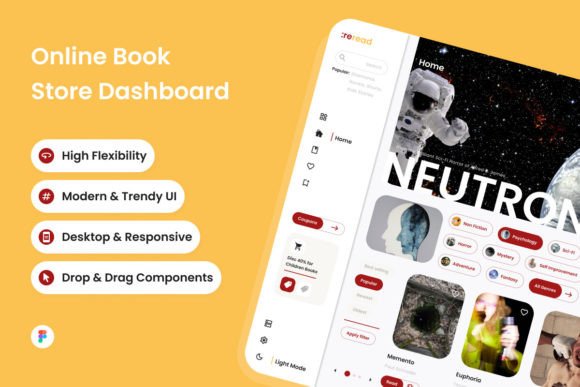
ReRead - Online Book Store Dashboard V2: Your Literary Command Center
Running an online bookstore feels like conducting an orchestra. Inventory management, trend analysis, customer engagement, and curated recommendations all need to play in harmony. That's where ReRead - Online Book Store Dashboard V2 enters the scene—not as another generic template, but as a thoughtfully crafted interface designed specifically for people who live and breathe books. Whether you're an independent publisher launching a direct-to-reader shop, a small business owner expanding into e-commerce, or a designer building a client's literary brand, this dashboard brings clarity to the beautiful chaos of selling stories.
A Dashboard That Understands the Book Business
What immediately sets ReRead V2 apart from countless other dashboard designs is its personality. The visual language feels warm yet professional, inviting without sacrificing functionality. The layout balances generous white space with carefully organized data panels, creating breathing room that prevents the overwhelm typical of management interfaces. Typography choices lean into modern typography principles—clean sans serif font pairings for interface elements that maintain readability across screen sizes, while allowing room for more expressive serif font or display font selections in branding overlays.
The color system deserves particular attention. Rather than relying on harsh contrasts or trendy gradients that age quickly, ReRead V2 uses a palette that complements book cover aesthetics. This matters more than you might think. When your dashboard feels cohesive with the products you're selling, the entire experience feels intentional. Customers notice that cohesion, even when they can't articulate why your store feels more trustworthy than the competition.
Both desktop and mobile versions receive equal design consideration here. That's a significant detail for bookstore owners who manage inventory from their phone between trade shows or check sales reports during commutes. The responsive design doesn't simply shrink elements—it reorganizes them thoughtfully, prioritizing the actions and data points most relevant to on-the-go decision making.
Design That Adapts to Your Brand
Every bookstore carries a distinct personality. A shop specializing in rare first editions communicates differently than one focused on contemporary romance or children's literature. ReRead V2 acknowledges this reality through its easy-to-adjust design architecture. Layers are organized logically, making customization straightforward even for designers who aren't deeply technical. The global text and color styles built into the Figma file mean you can shift the entire aesthetic direction with a few strategic edits rather than hunting through hundreds of disconnected elements.
This adaptability extends to brand identity work. If you're a content creator or blogger building a personal literary brand, the dashboard serves as both functional tool and design reference. The visual patterns established here—spacing ratios, component relationships, interaction hierarchies—can inform your broader web design language, social media graphics, and even editorial design for newsletters or promotional materials.
The open source fonts included eliminate licensing headaches that plague many design projects. For small business owners and entrepreneurs watching budgets carefully, knowing your typography won't generate unexpected costs provides genuine peace of mind. These aren't throwaway typefaces either—they're quality selections that hold their own in professional contexts.
Practical Applications Beyond the Bookstore
While ReRead V2 targets online bookstores specifically, its design principles transfer beautifully to adjacent projects. Publishers managing author catalogs will find the inventory organization patterns directly applicable. Marketers running literary campaigns can study the dashboard's data visualization approaches for presenting engagement metrics to clients. Even crafters and hobbyists selling handmade journals or bookish merchandise through platforms like Etsy could adapt the layout for their own inventory management needs.
The Figma compatibility matters here. As a design asset, ReRead V2 integrates into existing workflows without requiring new software investments. Designers already working in Figma can drop components into client presentations, extract spacing systems for development handoffs, or use the organized layer structure as a teaching tool for junior team members learning dashboard design conventions.
Evaluating Fit for Your Project
Before committing to any design asset, honest evaluation saves time and frustration. Start by mapping your actual needs against ReRead V2's capabilities. If your bookstore requires complex multi-vendor commission tracking or subscription box management, you'll likely need to extend the dashboard significantly. But if core inventory management, sales trend visualization, and recommendation curation represent your primary workflows, this template provides an excellent foundation.
Test font pairings early in your process. While the included open source fonts work well together, your specific brand might call for a more distinctive premium font or a creative font that signals your niche. A handwritten font accent could suit a cozy indie bookstore aesthetic, while a sharp geometric sans serif font might better serve a shop specializing in graphic novels or art books. Build quick mockups combining ReRead V2's structure with your typography candidates before finalizing decisions.
Pay attention to readability across contexts. Dashboard interfaces demand particular typographic discipline—users scanning sales figures at a glance need different visual hierarchy than readers settling into a novel's opening chapter. Ensure your chosen typefaces maintain legibility at small sizes common in data tables and notification badges.
The file's well-organized layers make exploration straightforward. Spend time navigating the component structure before diving into customization. Understanding how the original designer grouped related elements, named layers, and organized pages will accelerate your adaptation process considerably.
Building Community Through Better Interfaces
Ultimately, tools like ReRead V2 serve a deeper purpose than managing stock levels or tracking revenue. A thoughtfully designed bookstore interface communicates respect for the reading experience. It signals to visitors that this space was crafted by people who care about books, not just transactions. That perception builds the kind of audience engagement that transforms one-time buyers into devoted community members who recommend your shop to fellow readers.
For entrepreneurs and small business owners entering the competitive online book market, starting with professional design assets like ReRead V2 levels the playing field. You don't need a massive budget or a dedicated design team to present a polished, functional storefront. What you need is a solid foundation that respects your time, adapts to your vision, and grows alongside your business.
ReRead - Online Book Store Dashboard V2 delivers exactly that foundation. Explore it with your specific goals in mind, customize it with intention, and let it support the stories you're helping readers discover.